
The
Western
Front
Museum
Last updated:
Introduction
How much have we raised so far
How did we become involved
What is Leukaemia?
What is normal blood made up of?
How is leukaemia diagnosed and assessed?
Leukaemia & Lymphoma Research Fund
 Introduction
The aim of Leukaemia Research is to routinely cure every man, woman and child with leukaemia and related blood cancers by funding research into their causes. We are also dedicated to improving diagnosis, to devising new, less punishing treatments and to providing a vital support network for all patients nationally.
We fund research into all blood cancers including leukaemias, lymphomas, Hodgkin’s disease and myeloma. We currently fund researchers at major hospitals and universities throughout the UK, spending £20 million on life-saving research every year.

Our research is of global importance and is published in international journals worldwide. We have an annual meeting for our researchers, usually hosting eminent international speakers here in the UK. We also support medical students in their overseas electives and encourage our researchers to take fellowships in leading overseas laboratories. As well as having 2 non-UK based Europeans on our Medical & Scientific Advisory Panel, all our applications are sent for review internationally, with around 50% of the input coming from abroad.
Thanks to your help, our research is working, and lives are being saved, but there is still a lot more to be done. More than 90p of every £1 donated goes straight to research, but we are entirely dependent on voluntary contributions like yours.
Thank you for your support.
How much have we raised so far?
Thanks to the generousity of family members, colleagues and friends, several companies and local shop-keepers, we have managed to raise so far a staggering total of:
If you would like to make a contribution to the Leukaemia Research Fund please use this link:

with your payment. In this way the amount will be added to our contribution total.
TOP How did we become involved?
Our chairman of The Western Front Museum (J. Smit) owns a yellow Caterham Super Seven sportscar which he bought as kit in 1992 and completed in 1993. He soon became a member of the Lotus7Club Great Britain in 1994, and as non-UK member he was always surprised to read in
Low Flying (the club's superb monthly magazine) how well the club and many of its members are doing with regard to
raising money for a good cause such as the Leukaemia Research Fund. And yes, he bought in the past the occasional
raffle-tickets, but after all these years it became obvious that it was time as clubmember to do his bit.

Because he already did several long-distance cycletrips in previous years he could do another variation on the Lands End - John O'Groat, but other members have already done that if we're not mistaken. Basic rule is it needs to be done in his regular holiday and, because he likes a bit of sunshine along the way (who doesn't), he very much prefers the South of France (sorry, he is only human). And of course a solo trip, because most of the people he knows are simply not mad enough to join him in the ordeal. Who can blame them?
Maartensdijk (NL) - Stes. Marie de la Mer (South of France)
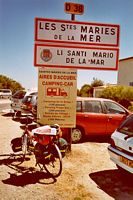 | 2001 |
Maartensdijk (NL) - Santiago de Compostela (Spain)
 | 2004 |
 | 2005 |
Maartensdijk (NL) - Venice (Italy) & Geneva (Switzerland)
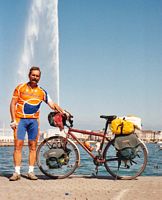 | 2006 |
Maartensdijk (NL) - North Sea Cycle Route
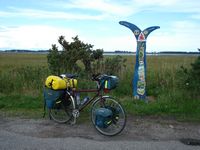 | 2009 |
TOP
What is Leukaemia?
Leukaemia is a cancer of cells in the bone marrow (the cells which develop into blood cells).
Cancer is a disease of the cells in the body. There are many types of cancer which arise from different types of cell. What all cancers have in common is that the cancer cells are abnormal and do not respond to normal control mechanisms. Large numbers of cancer cells build up because they multiply 'out of control', or because they live much longer than normal cells, or both.
With leukaemia, the cancerous cells in the bone marrow spill out into the bloodstream. There are several types of leukaemia. Most types arise from cells which normally develop into white blood cells. (The word leukaemia comes from a greek work which means 'white blood'.) If you develop leukaemia it is important to know exactly what type it is. This is because the outlook (prognosis) and treatments vary for the different types. Before discussing the different types of leukaemia it may help
to know some basics about normal blood cells and how they are made.
What is normal blood made up of?
Blood cells, which can be seen under a microscope, make up about 40% of the blood's volume. Blood cells are divided into three main types:
These make blood a red colour. One drop of blood contains about five million red cells. Red cells contain a chemical called haemoglobin. This binds to oxygen, and takes oxygen from the lungs to all parts of the body.
There are different types of white cells which are called neutrophils (polymorphs), lymphocytes, eosinophils, monocytes, and basophils. They are part of the immune system. Their main role is to defend the body against infection.
These are tiny and help the blood to clot if we cut ourselves.
Plasma is the liquid part of blood and makes up about 60% of the blood's volume. Plasma is mainly made from water, but contains many different proteins and other chemicals such as hormones, antibodies, enzymes, glucose, fat particles, salts, etc.
How is leukaemia diagnosed and assessed?
A blood test can often suggest the diagnosis of leukaemia as abnormal cells are often detected in the blood test. Further tests are usually done to confirm the diagnosis.
For this test a small amount of bone marrow is removed by inserting a needle into the pelvis bone (or sometimes the breastbone (sternum)). Local anaesthetic is used to numb the area. A small sample of bone may also be taken. The samples are put under the microscope to look for abnormal cells, and tested in other ways. This can confirm the diagnosis. (A separate leaflet describes bone marrow biopsy in more detail.) A bone marrow test may not be needed to confirm the diagnosis of CLL.
Detailed tests are often done on abnormal cells obtained from the bone marrow sample or blood test. These find out the exact type, or sub-type, of the cell that is abnormal.
This test collects a small amount of fluid from around the spinal cord (cerebrospinal fluid - CSF). It is done by inserting a needle between the vertebra in the lower (lumbar) region of the back. A separate leaflet describes this test in more detail. By examining the fluid for leukaemia cells, it helps to to find out if the leukaemia has spread to the brain and spinal cord. This is mainly done when assessing ALL, and sometimes AML.
A chest x-ray, blood tests, and other tests are done to assess your general wellbeing.
The treatment advised depends on the exact type of leukaemia, and the stage it is at. For example, ALL is usually treated as soon as possible with intensive chemotherapy. On the other hand, people in the early stages of CLL may not need any treatment. This is because CLL often progresses very slowly and may not need treatment for several years.
The outlook varies for each of the different leukaemias. However, the overall outlook may be better than many people imagine. For example, the outlook for ALL has greatly improved over the last 20 years or so. Most children with ALL (about 7-8 in 10 cases) can be cured. Also, the chronic leukaemias (CLL and CML) often progress slowly - often over several years. Even in those cases which are not cured, treatment with chemotherapy and other treatments can often prolong survival for quite some time.
TOP

Member of the N.V.B.M.B. (Dutch branch of the European Cartridge Research Association)
Copyright © The Western Front Museum Foundation